
Beyond the Greenback: Gold, Silver, Copper, and the Future
As we move through the first half of 2026, the financial landscape is witnessing a seismic shift. For years, the "60/40" portfolio was the gold standard, and Big Tech was the only game in town. But today, the narrative has changed. We are entering what many institutional desks are calling the "Hard Asset Era."
Arjun K A
3/26/20263 min read
Beyond the Greenback: Gold, Silver, Copper, and the Future
As we move through the first half of 2026, the financial landscape is witnessing a seismic shift. For years, the "60/40" portfolio was the gold standard, and Big Tech was the only game in town. But today, the narrative has changed. We are entering what many institutional desks are calling the "Hard Asset Era."
The challenge isn't just finding growth; it’s preserving purchasing power in an environment where the U.S. Dollar is facing structural headwinds and "sticky" inflation. The answer lies in dollar-denominated assets—specifically Gold, Silver, Copper, and Oil.
Here is why these four pillars are essential for your 2026 allocation sample strategy.
1. Gold: The Sovereign Anchor
In 2025, Gold shattered every glass ceiling, and in 2026, it has solidified its role as the ultimate "monetary insurance." We are seeing a historic divergence: gold is rallying even during periods of higher real yields.
The Driver: Central bank accumulation. Nations like China, India, and Turkey are aggressively diversifying away from the USD. For the first time in decades, gold isn't just a "fear trade"—it’s a reserve asset strategy.
Insights: We view Gold as the "base layer" of a portfolio. With price targets moving upwards, it serves as a hedge against the ballooning global debt crisis. It is the only asset that doesn't carry someone else's liability.
2. Silver: The High-Velocity "Hybrid"
If Gold is the steady anchor, Silver is the high-performance engine. In early 2026, we’ve seen Silver touch $80/oz, driven by a "perfect storm" of monetary demand and industrial scarcity.
The Driver: A fifth consecutive year of structural supply deficits. Silver is indispensable for the solar industry and the ongoing electrification of the global economy.
The Opportunity: Silver often lags behind Gold’s initial breakout but moves with significantly higher velocity. When the Gold/Silver ratio compresses, the gains in Silver can be breathtaking. For clients with a higher risk tolerance, Silver offers a dual-play on both "hard money" and "green tech."
3. Copper: The "New Oil" of the AI Age
You cannot have an AI revolution or a green energy transition without Copper. Period. As an RIA, we look at Copper as a leading indicator of global health—and right now, it’s screaming "supply crunch."
The Driver: Data center expansion and the "Smart Grid" rebuild. An AI-integrated data center requires significantly more copper wiring than a traditional one. Combined with aging mines in Chile and Peru, we are looking at a generational supply-demand imbalance.
Insights: Copper is no longer just a "base metal"; it is a strategic commodity. Including copper-exposed equities or physical ETFs provides a direct link to the infrastructure that powers the future.
4. Crude Oil: The Tactical Wildcard
Oil enters 2026 in a complex position. While the long-term trend points toward transition, the immediate reality is that the world still runs on fossil fuels.
The Driver: Geopolitical risk premiums and a "floor" established by the U.S. Strategic Petroleum Reserve (SPR) refills. While supply growth from non-OPEC nations has kept prices in check around the $85-$95 range, any flare-up in the Middle East or Eastern Europe sends this asset back into triple digits.
The Strategy: We use Oil as a tactical inflation hedge. It remains the most sensitive asset to "energy inflation," protecting portfolios when pump prices threaten consumer spending.
The Dollar Connection: Why Denomination Matters
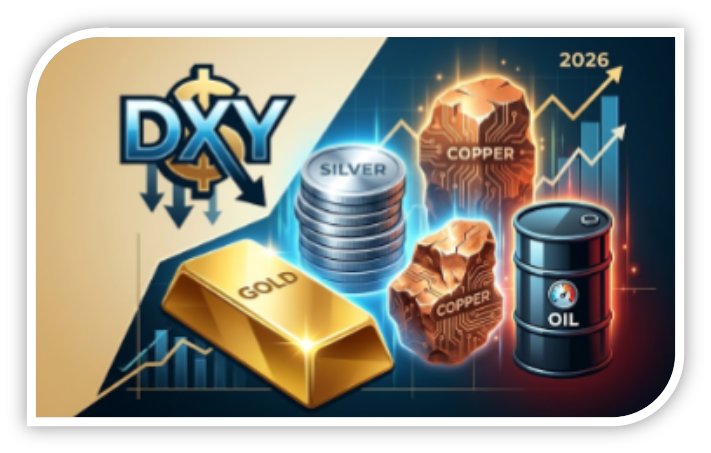
All these assets are priced in U.S. Dollars. This creates a powerful inverse correlation. As the Dollar Index (DXY) faces pressure from narrowing interest rate differentials and "de-dollarization" talk, these commodities naturally reprice higher.
Insights: A 10% drop in the value of the Dollar essentially acts as a 10% tailwind for Gold and Oil, even if their fundamental demand remains flat. In 2026, the "short Dollar" trade is effectively a "long Commodity" trade.
2026 Allocation Strategies: A Balanced Approach (sample only)
How should a modern portfolio look in this environment? We suggest moving away from the static 60/40 and toward a "Resilient 50/30/20" model:


he Cost of Waiting
The 2000s commodity super cycle lasted nearly a decade. We believe we are only in the third inning of this current cycle. For investors, the risk is no longer "volatility"—the risk is being under-allocated to the assets that are actually rising.
Our goal should be to ensure our wealth isn't just measured in paper currency, but in the tangible resources that the world needs to function.
Disclaimer – The blog is for educational purpose only, consult your Investment Adviser for your strategy.
to schedule a free introductory appointment
+91 81234 26999
FINSPIREYOU@OUTLOOK.COM
© 2026 All Rights Reserved Sukruthi Finspire You
Registration granted by SEBI (INA000020493) , Membership of Bombay Stock Exchange (BSE Enlistment number 2288), and certification from the National Institute of Securities Markets (NISM) in no way guarantee the performance of the Investment Advisor or provide any assurance of returns to Investors. Investments in the securities market are subject to market risks. Read all the related documents carefully.
ARJUN K A
pROPRIETOR sUKRUTHI