
Data is the New Oil: India's $50 Billion AI and Data Center Gold Rush
The old adage, "Data is the new oil," has never felt more prescient than it does today in India. We are witnessing a monumental shift as the world's largest technology companies—Amazon (AWS), Microsoft, Google, and global players like Cognizant—are pouring tens of billions of dollars into the country.
Arjun K A
12/12/202511 min read
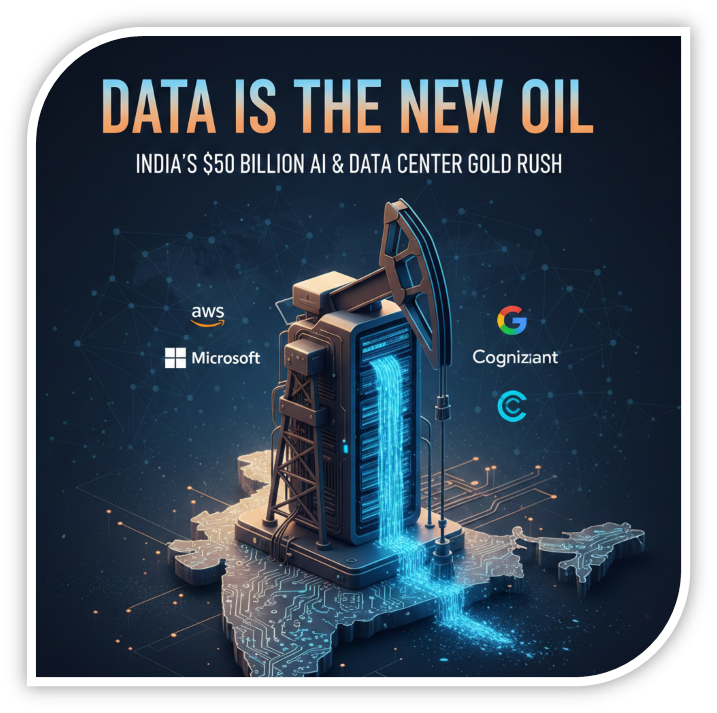
Their investment is not in traditional manufacturing or raw materials, but in the physical and intellectual infrastructure of the digital age: AI capabilities and hyperscale data centers.
This strategic pivot positions India at the epicenter of the global data economy. The recent announcements—including Amazon's expanded commitment to over $35 billion by 2030, Microsoft's $17.5 billion expansion plan, and Google's multi-billion dollar AI hub—collectively represent a bet of over $50 billion in a short span. This is more than just a capital investment; it is a profound structural reinforcement of India's role from being an outsourcing market to a core operating geography and a vital global AI lab.
🧠 The Core Theme: Building the AI-Data Engine
The fundamental principle driving this massive investment is the symbiotic relationship between data and Artificial Intelligence (AI). Data is the raw material, and AI is the refinery and engine.
Data as Fuel: India’s vast, diverse, and rapidly digitizing population generates data at an unparalleled scale. From digital payments (UPI) to e-commerce, tele-medicine, and citizen services, this real-world, high-volume data stream is the ultimate training ground for sophisticated AI models. If an AI model can navigate the complexity of India’s linguistic diversity (hundreds of active languages) and economic variation, it is robust enough for any global market.
Data Centers as Infrastructure: The hyperscale data centers being built by AWS (in regions like Hyderabad), Microsoft (across Hyderabad, Pune, and Gujarat), and Google are the physical repositories for this digital oil. They provide the necessary cloud computing power, storage, and, critically, the AI compute capabilities (driven by high-powered GPUs) required for training and running large language models (LLMs) and other advanced AI applications.
The AI Refinery: These investments are specifically targeting the creation of sovereign cloud capabilities and AI hubs—facilities designed to meet the nation's growing demand for data security, localization, and high-end processing, thereby turning raw data into actionable intelligence.
Prospects on Various Levels: The 5-10 Year Outlook
The impact of this capital influx is set to reshape India's economic, social, and geopolitical landscape over the next 5 to 10 years.
1. Economic Transformation and GDP Growth
Valuation of the Digital Economy: AI is projected to add over $1.7 trillion to India's economy by 2035. The tech sector, already set to cross $280 billion in revenue, will see a fundamental shift as data and AI become core revenue streams, moving beyond traditional IT services.
Boost to Allied Industries: The demand for energy-intensive data centers is driving massive parallel investments in renewable energy. Companies like the Tata Group are planning gigawatt-scale data center clusters, which will further accelerate India's green energy transition. This fosters a high-value manufacturing ecosystem for IT hardware and semiconductors.
Export and Startup Ecosystem: Amazon, for instance, aims to quadruple cumulative e-commerce exports enabled to $80 billion by 2030. The proliferation of affordable, high-speed cloud and AI infrastructure will democratize technology, fueling an explosion of AI-focused startups (India already hosts over 1,800 Global Capability Centres with a focus on AI).
2. Workforce and Skilling Revolution
Job Creation: The expansion will generate millions of new, high-value jobs. NASSCOM estimates the Indian IT sector will add 1 million AI-related jobs by 2025. This includes roles in AI research, data science, cloud architecture, cybersecurity, and data center operations.
Reskilling Mandate: Companies are doubling down on skilling. Microsoft has committed to training 20 million Indians in AI by 2030. This massive reskilling effort is essential to bridge the talent gap, shifting the workforce from basic IT services to complex AI engineering and data governance roles. The focus will be on deep tech skills in areas like machine learning engineering and ethical AI development.
3. Societal and Governance Impact
Inclusion and Digital Divide: AI-driven services, powered by localized data centers, will improve public service delivery. Examples include AI-powered diagnostics in healthcare to address doctor shortages in rural areas, and precision farming for small farmers (like Microsoft's AI for Farmers Initiative). This promises to bridge the urban-rural digital divide.
The Cognizant Factor: IT services giants like Cognizant are key integrators in this transition. They are on the front lines, leveraging the new infrastructure to implement AI solutions across the BFSI (Banking, Financial Services, and Insurance), healthcare, and retail sectors, accelerating the digital transformation of Indian enterprises.
Data Sovereignty and Policy: The large-scale domestic data center investment directly supports the Indian government's push for data sovereignty. Storing and processing Indian data on Indian soil is a strategic imperative, fostering trust and enabling better regulatory oversight of critical data.
⚠️ Challenges and The Road Ahead
While the prospects are overwhelmingly positive, the next decade will present critical challenges:
Ethical AI and Bias: Training AI models on India's diverse data must be done with robust ethical frameworks to mitigate societal bias and ensure fairness, especially in critical sectors like finance and law enforcement.
Job Displacement: Automation, powered by the very AI systems being built, could displace jobs in low-skill, repetitive sectors. Proactive policy and reskilling for those affected will be crucial to prevent labor distress and rising inequality.
Infrastructure Sustainability: The energy and water demands of hyperscale data centers are significant. The sustainability of this growth hinges on the rapid development and utilization of green energy solutions.
🚀 The Positive Impact: Who Benefits from India’s AI Gold Rush?
The massive $50+ billion investment by tech giants like Amazon, Microsoft, Google, and Cognizant is set to democratize advanced technology and create multi-layered opportunities across India.
1. Graduates
Graduates gain access to an explosion of high-value job roles in data science, AI engineering, and cloud architecture within global tech hubs.
Companies like Microsoft are committed to training millions, ensuring fresh talent is equipped with the cutting-edge AI-first skills demanded by the industry.
2. IT Field Professionals
The industry will transition from routine outsourcing tasks to complex, high-margin projects focused on building and managing Sovereign Cloud and Generative AI solutions.
IT professionals can reskill into core AI development and platform management, securing higher salaries and positioning India as an AI innovation partner, not just a service provider.
3. Entrepreneurs & Startups
Startups benefit from significantly cheaper, faster access to hyperscale AI compute power (GPUs) and comprehensive cloud services housed within India.
This democratized infrastructure fuels hyperlocal innovation, allowing entrepreneurs to build sophisticated AI-driven solutions for Indian-specific problems like logistics, agriculture, and healthcare.
4. Business Professionals (Non-IT)
Business leaders gain powerful AI tools (like Copilots) integrated into core functions, allowing for better decision-making, predictive analytics, and massive efficiency gains across operations.
The expansion drives digital transformation in allied sectors like manufacturing, finance, and logistics, creating demand for professionals who can strategically apply AI at an enterprise level.
5. Normal People / Citizens
Citizens will experience improved public service delivery through AI-powered governance, such as faster administrative processes and better-targeted welfare schemes.
Everyday life improves through enhanced services in healthcare (AI-powered diagnostics/telemedicine) and education (personalized learning), bridging the social and economic divides.
The rapid advancement and massive foreign investment in data and AI infrastructure pose significant, though manageable, threats to India's digital sovereignty.
This is a central topic in Indian policy and business discussions, and it boils down to the concept of strategic dependency.
Here are the main threats due to these advancements:
1. Lack of Control Over Core Technology (Strategic Dependency)
The Foundational Layer: The majority of India's AI application ecosystem relies on foundational models (LLMs) and core compute platforms (cloud infrastructure) owned, developed, and controlled by foreign tech giants (AWS, Microsoft Azure, Google Cloud). India is currently a major consumer of this technology, not a major creator.
The Threat: This creates a geopolitical vulnerability where a foreign government's laws (like the U.S. CLOUD Act) or sanctions could potentially dictate access to or control over critical Indian data and AI systems, even if the data resides physically within Indian data centers. This reliance compromises the nation's strategic autonomy in the digital realm.
2. Economic Leakage and Innovation Stagnation
Financial Outflow: Despite the massive local investment, the operational fees and licensing costs for using foreign cloud services and proprietary AI platforms can lead to significant economic leakage—funds that leave India rather than recirculating within a domestic tech ecosystem.
The Threat: The dominance of a few global hyperscalers can stifle the emergence of a competitive, indigenous Indian cloud and AI ecosystem, preventing domestic players from developing the necessary scale and expertise in the core foundational layers.
3. Data Colonialism and AI Bias
Training Data Giveaway: India's vast and diverse data is the most valuable raw material. When Indian enterprises and citizens use foreign AI models, this highly valuable, unique training data helps to refine and improve those foreign models.
The Threat: Foreign companies build unparalleled AI intelligence using Indian data as a strategic economic asset, without necessarily being required to share the full value or the intellectual property (IP) of the refined models with India. Furthermore, AI models developed outside of India may harbor biases that are detrimental or irrelevant to the diverse Indian cultural, linguistic, and economic context.
4. Regulatory and Enforcement Challenges
Jurisdictional Conflict: While India's Digital Personal Data Protection (DPDP) Act mandates certain data handling requirements, actual data control is complicated by the transnational nature of cloud computing, where data may be mirrored, processed, or accessed from other global regions.
The Threat: In a national security or severe regulatory conflict, the Indian government may face difficulties in compelling a foreign entity to comply fully or immediately, especially if that compliance violates the laws of the company's home country.
✅ India's Mitigating Measures (The Path to Sovereign Cloud)
It is crucial to note that the foreign investments themselves are increasingly being channeled to mitigate these very risks, often at the request of the Indian government:
Sovereign Cloud & Data Localization: The government mandates (and foreign companies are responding with) the construction of Sovereign Public and Private Clouds within India. These are specifically designed to meet strict regulatory and compliance guardrails, ensuring sensitive government, defence, healthcare, and financial data never leaves Indian soil.
Building the Digital Public Infrastructure (DPI) Stack: India is promoting its own open-source technology stack, like UPI (for payments) and ONDC (for e-commerce), and is now actively working on indigenous foundational AI models to reduce reliance on foreign-developed alternatives.
Skilling and Talent: The massive skilling commitments by companies like Microsoft (training 20 million Indians in AI by 2030) are essential for building the domestic talent pool capable of developing and managing a sovereign tech stack.
In short, the threat is real and is one of dependency, but the investment, combined with strong regulatory policy and the push for indigenous DPI, is creating a high-stakes, multi-billion-dollar race for true digital self-rule.
The Sovereign Cloud concept is an architecture designed specifically to leverage the benefits of cloud computing (scale, agility) while rigorously addressing the threats to national digital sovereignty.
Here are the five precise ways Sovereign Cloud addresses these threats in the Indian context:
1. Guaranteed Jurisdictional Control: It ensures that all data, including metadata and encryption keys, is physically stored and processed within India and is therefore exclusively governed by Indian laws (like the DPDP Act). This immunity protects the data from foreign legal demands, such as those made under the U.S. CLOUD Act.
2. Restricted Operational Access: Sovereign Cloud models enforce strict rules on who can physically access the data and the underlying infrastructure. Access is often limited to background-verified Indian citizens, preventing unauthorized administrative interference by foreign nationals.
3. Mitigated AI Bias and Data Colonialism: By keeping AI training data local and securing the entire computing stack, the Sovereign Cloud provides a trusted environment for developing indigenous AI models that are trained on diverse Indian context data, preventing the uncompensated outflow of strategic data assets.
4. Enhanced Compliance and Trust: The infrastructure is pre-architected and continually audited to meet mandatory regulatory requirements for highly sensitive sectors (Defense, Finance, Healthcare). This built-in compliance simplifies legal obligations and builds citizen and enterprise trust in the digital ecosystem.
5. Fostering Technological Autonomy: While often leveraging technology from global players (like Microsoft Azure or AWS Local Zones), the Sovereign Cloud model encourages strategic partnerships and the use of indigenous components, gradually reducing the nation's structural dependency on foreign tech providers for critical national systems.
🔮From Data Hoarder to Data Power
The phrase "Data is the new oil" accurately captures the immense intrinsic value of this resource. However, what is unfolding in India is the creation of the entire value chain: the oil fields (data generation), the refineries (AI platforms), and the distribution network (data centers).
The colossal investment by Amazon, Microsoft, Google, and the implementation strength of partners like Cognizant signify a definitive shift. India is transforming from a consumer of global technology to a key global producer and testing ground for AI.
In 5 to 10 years, India will not just be one of the largest digital markets, but a Data Power—a crucible of AI innovation that will shape the future of technology, not just for its own 1.4 billion citizens, but for the entire world. This is the new digital frontier, and the world's tech giants are making their stand.
⚙️ Data Center & Infrastructure FAQs
1. What is a Data Center? A data center is a dedicated physical facility that centralizes an organization's computing infrastructure, including servers, storage systems, and networking equipment, for the purpose of storing, processing, and distributing large amounts of data.
2. What is a Hyperscale Data Center? A hyperscale data center is a massive facility built and operated by large cloud providers (like AWS, Google, Microsoft) that is designed for extreme scale, housing thousands of servers and offering virtually unlimited, rapid scalability.
3. What is the key role of Data Centers in the AI boom? Data centers provide the massive AI Compute power, primarily through high-density server racks equipped with specialized GPUs, which are essential for training large language models (LLMs) and running complex AI applications.
4. What are the main components of a Data Center? The four main components are Compute (servers/racks), Storage (SAN/NAS), Network (routers/switches/cabling), and Infrastructure (power, cooling, and security systems).
5. What is latency, and how do Data Centers reduce it? Latency is the delay before a data transfer begins following an instruction. Data centers reduce it by being located geographically closer to the end-users they serve, ensuring faster response times for applications like online banking and gaming.
🛡️ Data Sovereignty & Sovereign Cloud FAQs
6. What is Data Sovereignty? Data sovereignty is the principle that data is subject to the laws and governance of the country or jurisdiction in which it is collected and processed, ensuring control remains local.
7. How is Data Residency different from Data Sovereignty? Data Residency simply refers to the physical location where data is stored (e.g., in an Indian data center). Data Sovereignty is the legal control, ensuring the data is only subject to the laws of that location (India's laws).
8. What is a Sovereign Cloud? A Sovereign Cloud is a cloud computing environment designed to meet the highest national legal and regulatory requirements, ensuring that data, access, operations, and infrastructure remain under the strict control of a specific nation or jurisdiction.
9. What primary threat does Sovereign Cloud address? It addresses the threat of extraterritorial legal demands, preventing foreign governments from accessing critical national or citizen data through their own foreign laws (like the U.S. CLOUD Act), even if the data resides locally.
10. How is Sovereign Cloud different from a standard Public Cloud? While both offer scalable services, a Public Cloud is typically governed globally, whereas a Sovereign Cloud enforces strict limitations on access and operations (often restricting cloud administrator roles to specific citizens) and adherence to local laws.
11. What is meant by "Operational Sovereignty"? Operational Sovereignty ensures that the monitoring, management, maintenance, and technical support of the cloud infrastructure is performed exclusively by personnel who meet defined local security and citizenship requirements.
12. Can a global cloud provider offer a Sovereign Cloud? Yes, but they do so through dedicated architectures, specific partnerships with local entities, or isolated regions (like AWS Dedicated Local Zones or Microsoft Cloud for Sovereignty), where operations and access are highly restricted by contract and technology.
13. Which sectors mandate the use of Sovereign Cloud? Sectors handling highly sensitive data typically mandate it, including Government (defence, citizen ID), Finance (central banks, core banking), and Healthcare (patient records and national health data).
14. What is the impact of Sovereign Cloud on regulatory compliance? It dramatically simplifies compliance with national data protection laws (like India's DPDP Act) because the infrastructure is purpose-built and audited to meet these domestic legal mandates from the outset.
15. Does using a Sovereign Cloud hinder global business? No; many businesses adopt a Hybrid Cloud model, using the Sovereign Cloud for highly regulated, sensitive data and core systems, while using the standard Public Cloud for general workloads and global customer interactions.
to schedule a free introductory appointment
+91 81234 26999
FINSPIREYOU@OUTLOOK.COM
© 2026 All Rights Reserved Sukruthi Finspire You
Registration granted by SEBI (INA000020493) , Membership of Bombay Stock Exchange (BSE Enlistment number 2288), and certification from the National Institute of Securities Markets (NISM) in no way guarantee the performance of the Investment Advisor or provide any assurance of returns to Investors. Investments in the securities market are subject to market risks. Read all the related documents carefully.
ARJUN K A
pROPRIETOR sUKRUTHI