
Modi-Merz Summit 2026: Germany Ends Transit Visa for Indian Passport Holders
New 2026 rules: Germany announces visa-free transit for Indian passport holders. No more ATV needed for Frankfurt or Munich.
Arjun K A
1/14/20264 min read
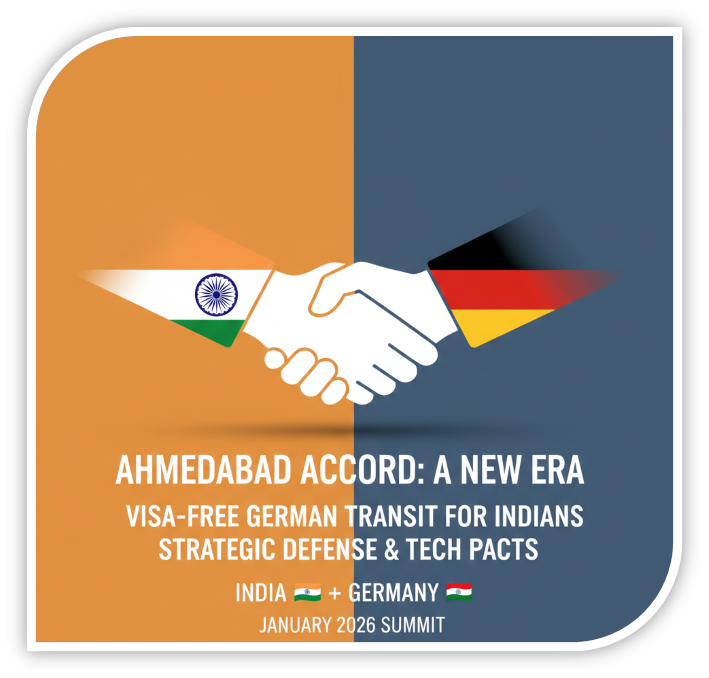
The seismic shift in Indo-German relations following the landmark January 2024 (and reinforced in 2026) summit.
The Breakthrough: A New Era for India-Germany Strategic Partnership
The geopolitical landscape of Eurasia shifted significantly this week as Prime Minister Narendra Modi and German Chancellor Friedrich Merz concluded a historic summit in Ahmedabad. Marking the 75th anniversary of diplomatic ties, the meet was far more than a ceremonial exchange; it was a high-octane recalibration of trade, mobility, and defense.
For Indian citizens, the most immediate "win" is the visa-free transit announcement, but for the global economy, the 19 signed agreements signal that Germany is officially pivoting its "China-plus-one" strategy toward India.
1. Mobility Revolution: Visa-Free Transit for Indians
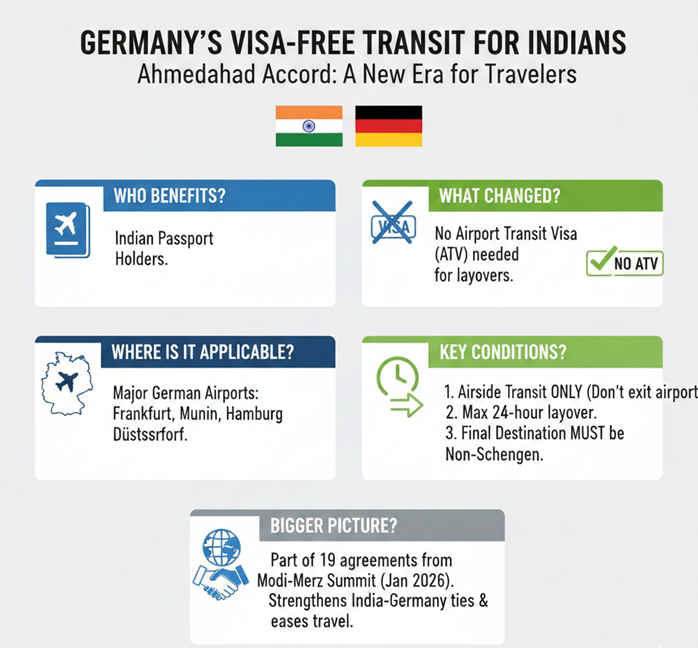
In a move that drastically simplifies international travel, Germany has scrapped the Airport Transit Visa (ATV) requirement for Indian passport holders.
Previously, Indians flying to non-Schengen destinations (like the US, UK, or Canada) via German hubs like Frankfurt or Munich had to navigate a tedious, €90 visa process. Now, Indian travellers can transit through the international zones of five major German airports without a visa, provided they stay airside and depart within 24 hours. This move positions Germany as the preferred gateway for the Indian diaspora, rivaling Middle Eastern hubs like Dubai and Doha.
2. The Defense Pivot: From Buyers to Partners
Perhaps the most "powerful" pillar of the summit was the Roadmap on Defense Industrial Cooperation. Germany has traditionally been cautious with defense exports to non-NATO countries. However, the Merz administration has signaled a green light for:
Project 75-I Submarines: A multi-billion dollar deal where Thyssenkrupp Marine Systems (TKMS) will co-build six advanced conventional submarines in Indian shipyards.
Co-development: Shifting from "off-the-shelf" purchases to joint intellectual property (IP) creation in aerospace and maritime security.
3. The Green Energy Corridor: Ammonia and Hydrogen
Germany’s industrial engine is hungry for clean energy, and India is poised to be its primary gas station. A standout commercial success of the summit was the Green Ammonia Offtake Deal.
Under this agreement, Indian firm AM Green will supply 500,000 tons of green ammonia annually to Germany’s Uniper. This isn't just a trade deal; it’s a template for the global energy transition, backed by €1.24 billion in German funding for India’s green infrastructure.
4. Tech Sovereignty: Semiconductors and AI
As the world moves toward "de-risking" supply chains, the Semiconductor Ecosystem Partnership signed in Ahmedabad is critical. By aligning German precision engineering with India’s massive design talent pool, both nations aim to insulate themselves from future microchip shortages. This is bolstered by new agreements in 6G technology and Artificial Intelligence, ensuring that the "digital twins" of both nations remain synchronized.
5. Bridging the Talent Gap: Healthcare and Education
Germany faces a massive labor shortage, and India has a surplus of skilled professionals. To address this, a new framework was established for the fair recruitment of Indian healthcare workers.
Unlike the "brain drain" of the past, this is a "brain gain" model. German universities are now incentivized to open campuses in India, and the Roadmap on Higher Education ensures that degrees are mutually recognized, making the transition for Indian students and professionals seamless.
The CEO Power List: Who Was at the Table?
The summit wasn't just a political meeting; it was an industrial board meeting. The delegation included 25 titans of industry:
Siemens & DHL: Modernizing India’s logistics and smart cities.
Infineon: Investing in India’s semiconductor talent.
Boehringer Ingelheim: Expanding clinical research in the subcontinent.
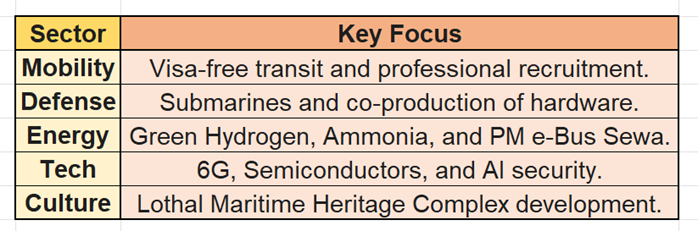
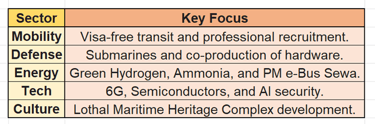
Summary: The 19 Agreements at a Glance
To understand the sheer scale of this visit, here is a breakdown of the core MoUs:
Why This Matters Now
The Modi-Merz summit proves that India and Germany are no longer just "trading partners"—they are strategic anchors for each other. For India, Germany offers a gateway to European technology and capital. For Germany, India offers the scale, talent, and democratic reliability it needs in an uncertain global order.
FAQs
1. What is the current volume of bilateral trade?
Bilateral trade hit a record $51.23 billion in FY 2024-25, with Germany remaining India's largest EU trading partner.
2. Which sectors are the primary drivers of growth?
Key drivers have shifted to Semiconductors, Green Hydrogen, AI, and Defense, alongside traditional machinery and chemicals.
3. How many German companies operate in India?
Over 2,000 German firms (like Bosch and Siemens) are active in India, contributing significantly to the "Make in India" initiative.
4. What is the status of the Green Partnership?
Germany has utilized nearly €5 billion of its €10 billion commitment to fund India's solar, wind, and green hydrogen projects by 2030.
5. Are there new visa incentives for Indian professionals?
Germany now offers visa-free airport transit for Indian passport holders and streamlined work visas for STEM and healthcare talent.
6. Where do India-EU Free Trade Agreement (FTA) talks stand?
Negotiations are in the final phase as of January 2026, with both nations pushing for a conclusion at the upcoming EU-India Summit.
7. How are the two nations collaborating on semiconductors?
A Semiconductor Ecosystem Partnership was signed in 2026 to align German engineering with Indian manufacturing and chip design.
8. What is the impact of the "China Plus One" strategy?
German firms are increasingly choosing India as a Global Capability Centre (GCC) and production hub to reduce supply chain dependence on China.
9. What were the outcomes of the January 2026 Summit?
Chancellor Friedrich Merz's visit resulted in 19 new agreements, including a roadmap for defense co-production and critical mineral security.
10. Is there a major defense deal currently in progress?
India and Germany are in advanced talks for an $8 billion deal to co-build six advanced stealth submarines at Mazagon Dock.
to schedule a free introductory appointment
+91 81234 26999
FINSPIREYOU@OUTLOOK.COM
© 2026 All Rights Reserved Sukruthi Finspire You
Registration granted by SEBI (INA000020493) , Membership of Bombay Stock Exchange (BSE Enlistment number 2288), and certification from the National Institute of Securities Markets (NISM) in no way guarantee the performance of the Investment Advisor or provide any assurance of returns to Investors. Investments in the securities market are subject to market risks. Read all the related documents carefully.
ARJUN K A
pROPRIETOR sUKRUTHI