
The Decade of Blue: How Beijing Engineered the World’s Fastest Green Turnaround
Arjun K A
12/19/20256 min read
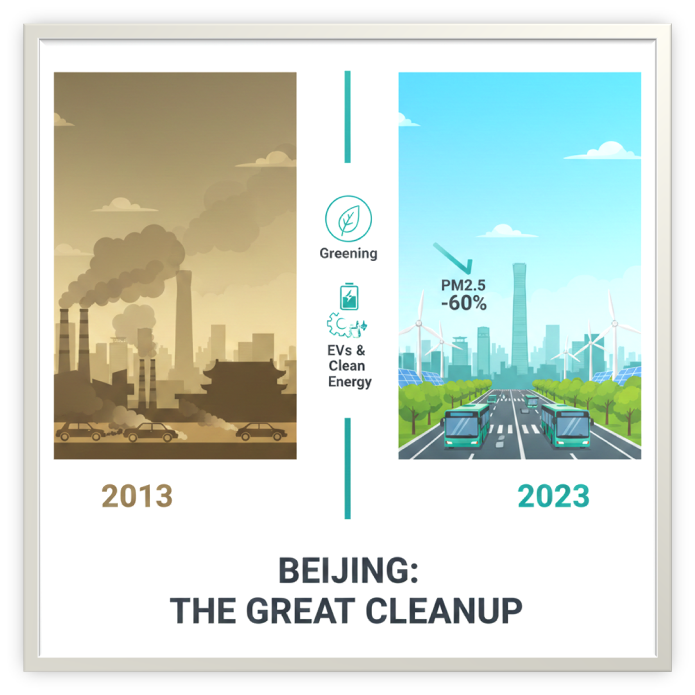

In just one decade, Beijing has undergone a radical shift, evolving from a city shrouded in hazardous smog to a global model for sustainable city transformation. The results are staggering: a 60% PM2.5 reduction that has effectively added years back to the lives of its residents. This transition was anchored in a rigorous environmental policy in China, which prioritized ecological health alongside economic growth. Through a massive coal-to-gas transition and the aggressive electrification of public transport, the city dismantled its heavy reliance on fossil fuels. As a definitive Beijing air quality case study, this journey offers more than just hope; it provides a proven technical and political roadmap for other megacities. By implementing high-tech monitoring and regional coordination, Beijing has demonstrated that urban smog solutions are not only possible but can yield a significant return on investment for public health and future prosperity.
The 10 key factors that drove this transformation:
1. The "Air Ten" Action Plan (2013)
The turning point was the 2013 National Action Plan on Air Pollution Prevention and Control. It set clear, legally binding targets for the Beijing-Tianjin-Hebei region. For the first time, local officials were promoted or demoted based on their ability to meet environmental targets, rather than just economic growth.
2. Radical Shift from Coal to Gas
Beijing effectively "de-coaled" the city. In 10 years, it replaced nearly all coal-fired heating systems in over 1.3 million households with natural gas or electric heating. The city also closed its last four major coal-fired power plants, replacing them with gas-fired ones.
3. Industrial Relocation and Restructuring
The government shut down or relocated thousands of heavy, polluting industries. A famous example is the Shougang Steel Group, one of China's largest steelmakers, which was moved entirely out of Beijing to Hebei province. This move alone significantly reduced inhalable particles in the city's air.
4. Ultra-Strict Vehicle Emission Standards
Beijing adopted "China VI" emission standards—some of the strictest in the world (comparable to Euro 6). They phased out millions of high-emission "yellow label" vehicles and implemented a lottery system to limit the number of new internal combustion engine cars on the road.
5. Massive Push for New Energy Vehicles (NEVs)
The city heavily subsidized electric vehicles (EVs). Today, Beijing's entire bus fleet and a significant portion of its taxis and logistics trucks are electric. EV owners in Beijing also enjoy exemptions from the traffic restrictions that apply to gas-powered cars.
6. Regional Coordination (BTH Region)
Pollution doesn't respect city borders. Beijing coordinated with neighboring Tianjin and Hebei province to create a unified monitoring and emergency response system. This ensured that when a "pollution wave" was coming, factories across the entire region—not just in Beijing—were ordered to scale back production.
7. Real-Time Monitoring and Transparency
China built one of the world’s most sophisticated air quality monitoring networks. Thousands of sensors provide real-time data to the public via apps. This transparency held the government accountable and increased public awareness, shifting the "air crisis" from a technical problem to a social priority.
8. Massive Urban Greening
Beijing created a "Green Necklace" around the city—a series of parks and forest belts designed to trap dust and reduce the heat island effect. Millions of trees were planted to create "wind corridors" that help disperse stagnant air during the winter months.
9. Winter Olympic Catalyst (2022)
The 2022 Winter Olympics acted as a final sprint. To ensure "Olympic Blue" skies, the government accelerated many of its long-term goals, including the deployment of hydrogen-powered transport and the 100% use of renewable energy for all Olympic venues.
10. Financial Investment
The scale of funding was unprecedented. Beijing’s budget for air pollution control jumped from 3 billion yuan (~$430M) in 2013 to over 18 billion yuan (~$2.6B) annually by 2017. Total investment across the region reached hundreds of billions of dollars over the decade.
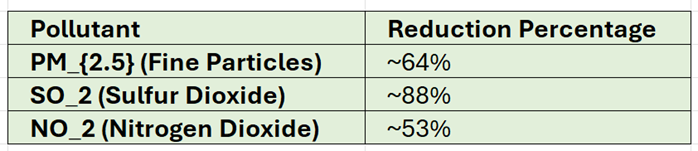
The transformation of Beijing’s air quality from 2013 to 2023 is often described by environmental economists as the most rapid decline in particulate pollution ever recorded in a major megacity. What took London and Los Angeles three to five decades to achieve, Beijing accomplished in ten.
This transformation moved through four distinct, powerful stages of evolution.
Stage 1: The Awakening and The Mandate (2013–2014)
Before 2013, "smog" was often euphemistically called "fog." The turning point was the "Air Apocalypse" of January 2013, when PM_{2.5} levels skyrocketed to $700\mu g/m^3$—nearly 30 times the WHO safety limit.
The response was the National Action Plan. This stage was characterized by political accountability. For the first time, the central government decoupled local official promotions from GDP growth alone, making air quality a "make-or-break" KPI. This shifted the mindset of leadership from industrial expansion at all costs to environmental survival.
Stage 2: The Structural Surgery (2015–2017)
If Stage 1 was about planning, Stage 2 was about "radical surgery" on the city's energy marrow. Beijing began the aggressive de-coaling of its economy.
Industrial Demolition: The city shuttered its last four major coal-fired power plants.
Residential Overhaul: In a massive logistical feat, over a million households in the "coal-to-gas" and "coal-to-electricity" project saw their traditional coal boilers replaced by modern heating units, often subsidized by up to 90% by the state.
The Iron Fist: Heavy industries, including the massive Shougang Steel works, were physically moved hundreds of kilometers away.
Stage 3: The Technological Shield (2018–2020)
As the "low-hanging fruit" of heavy industry was addressed, Beijing turned to high-tech precision. This stage saw the birth of the world’s most sophisticated environmental monitoring grid.
The city was divided into a high-resolution grid where over 1,000 sensor stations provided real-time data. This allowed authorities to identify "pollution hotspots" down to specific street blocks. Simultaneously, the city pivoted to the New Energy Vehicle (NEV) Revolution. By implementing a quota system that made it nearly impossible to register a new gas car while fast-tracking electric vehicles, Beijing transformed its fleet. Every public bus and nearly every taxi transitioned to electric power, eliminating tailpipe emissions in the city’s densest corridors.
Stage 4: The Ecological Harmonization (2021–2023)
The final stage focused on resilience and regional synergy. Recognizing that 30% of Beijing’s pollution was blown in from neighboring provinces, the "Beijing-Tianjin-Hebei" (BTH) coordination body was empowered to synchronize factory shutdowns across provincial lines during stagnant weather patterns.
The city also invested in its "Green Lung." Massive reforestation projects created a wind corridor to the north, designed to facilitate the flow of clean air from the Mongolian plateau and trap dust before it reached the urban center. By the time of the 2022 Winter Olympics, the "Beijing Blue" that many thought was a temporary phenomenon had become the new statistical norm.
The Decadal Impact
The results of this structured assault on pollution are staggering:
PM_{2.5} Concentration: Dropped from roughly 89.5\mu g/m^3 in 2013 to approximately 30\mu g/m^3 in 2023.
Health Outcomes: Studies suggest these measures have added an average of 3.2 years to the life expectancy of Beijing’s 21 million residents.
Beijing’s decade proves that with absolute political will, massive financial capital, and data-driven enforcement, environmental degradation is not an inevitable price of development—it is a reversible policy choice.
The economic vs. public health breakdown of the transformation.
1. The Financial Costs: A Massive Capital Layout
The "War on Pollution" required an unprecedented level of capital investment, transitioning from a "growth-first" model to a "green-first" model.
Direct Government Spending: Beijing’s annual budget for air pollution control grew from 3 billion yuan (~$430M) in 2013 to over 18 billion yuan (~$2.6B) by 2017. Total national investment for the "Air Ten" plan (2013–2017) reached approximately 1.65 trillion RMB (~$230 billion).
Infrastructure Transition: The shift from coal to gas for over 1.3 million households was heavily subsidized, with the government covering up to 90% of installation costs to prevent a heating crisis for low-income residents.
Industrial Opportunity Cost: Shutting down or relocating thousands of factories (including the massive Shougang Steel) resulted in short-term local GDP dips and significant costs for worker retraining and relocation.
2. Public Health Savings: The "Longevity Dividend"
The primary "profit" from this investment is measured in human lives and healthcare savings.
Extended Life Expectancy: Research from the Energy Policy Institute at the University of Chicago (EPIC) indicates that if the current air quality improvements are sustained, the average Beijing resident is expected to live 4.6 years longer than they would have under 2013 pollution levels.
Reduced Premature Mortality: In the broader Beijing-Tianjin-Hebei (BTH) region, the reduction in PM_{2.5} is estimated to have prevented over 100,000 premature deaths between 2013 and 2017 alone.
Avoided Healthcare Expenses: Studies estimate that cleaner air has led to an 8–10% reduction in total health expenditures related to respiratory and cardiovascular diseases (like COPD and stroke).
3. Economic Productivity Gains
Cleaner air isn't just about health; it is a driver of labor productivity.
Labor Supply: By reducing "morbidity days" (days people are too sick to work), Beijing has recaptured millions of hours of labor productivity. In the BTH region, pollution-related work-time loss was reduced by an estimated 24% by 2020.
The "Brain Gain": Persistent smog was causing a "brain drain" of high-level international and domestic talent fleeing the city. Improving air quality restored Beijing’s competitiveness as a global tech and financial hub.
Delhi could adapt by shifting from reactive, seasonal emergency measures like GRAP to a unified, long-term regional strategy that enforces strict industrial and vehicular standards across all neighbouring states. Success would require mirroring Beijing’s model of tying political accountability to air-quality targets and making the massive financial investments needed for a full-scale transition to clean energy and electric mobility.
to schedule a free introductory appointment
+91 81234 26999
FINSPIREYOU@OUTLOOK.COM
© 2026 All Rights Reserved Sukruthi Finspire You
Registration granted by SEBI (INA000020493) , Membership of Bombay Stock Exchange (BSE Enlistment number 2288), and certification from the National Institute of Securities Markets (NISM) in no way guarantee the performance of the Investment Advisor or provide any assurance of returns to Investors. Investments in the securities market are subject to market risks. Read all the related documents carefully.
ARJUN K A
pROPRIETOR sUKRUTHI