
The Digital Rupee Divided: Analyzing India's Dual CBDC Strategy for Domestic Efficiency and Global Supremacy
Arjun K A
12/9/20258 min read
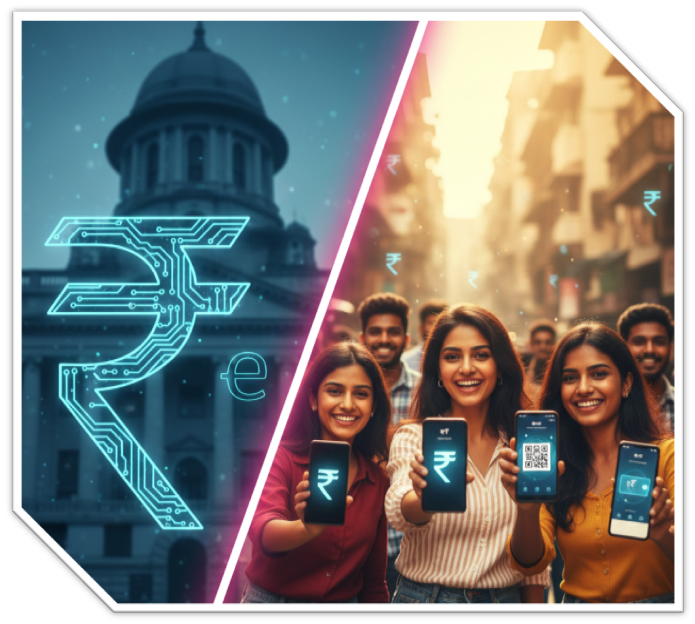

It is not merely about digitizing cash; it is about fundamentally restructuring the domestic financial plumbing while simultaneously engineering a pathway for the Rupee to play a larger, more efficient role in the global cross-border payments landscape.
The Engine of Financial Markets: Wholesale CBDC (e₹-W)
The Wholesale CBDC (e₹-W) was the first phase of the Digital Rupee pilot, launched in late 2022. Its target audience is not the consumer, but the high-level financial institutions: commercial banks, financial market participants, and the RBI itself. The goal of e₹-W is a quiet, yet radical, overhaul of the systems that underpin the entire economy.
1. Reducing Settlement Risk and Capital Costs
Currently, the settlement of large-value interbank transfers and the trading of government securities rely on existing systems which can expose banks to counterparty risk and liquidity risk.
The e₹-W Solution: By leveraging the ledger of the e₹-W, interbank payments and securities settlements can be made in real-time gross settlement (RTGS). This is often termed "atomic settlement", where the transfer of money and the transfer of the asset (like a government bond) happen simultaneously and irrevocably.
The Impact: This eliminates the time lag inherent in traditional T+1 (Trade date plus one day) or T+2 settlements, drastically lowering the risk of a financial institution failing to deliver on its obligation. For banks, this reduces the need to hold large amounts of collateral and liquidity to manage this risk, freeing up capital for lending and investment, thereby enhancing overall market efficiency.
2. Streamlining Government Securities Trade
The e₹-W pilot’s primary focus was the settlement of government securities in the secondary market. A streamlined, near-instantaneous settlement mechanism for these high-value transactions increases liquidity and reduces friction, making the market more attractive and robust. This technological upgrade provides the RBI with a modern tool to manage the money supply and conduct monetary policy more efficiently.
The Tool for the People: Retail CBDC (e₹-R)
The Retail CBDC (e₹-R), launched shortly after its wholesale counterpart, is the consumer-facing digital currency. It is designed to be a digital equivalent of physical cash, offering a secure, risk-free alternative for the general public.
1. Cost Reduction and Resilience of Cash Management
India's vast geography and high population density make the management of physical cash—printing, transporting, storing, and securing—an enormous and costly logistical undertaking for the RBI and commercial banks.
The e₹-R Solution: The digital nature of e₹-R inherently eliminates these operational costs. Furthermore, since e₹-R is a direct liability of the RBI (unlike commercial bank deposits), it offers the public a risk-free store of value that cannot be affected by commercial bank failure, boosting public trust in the financial system.
2. Financial Inclusion via Offline Capability
While India boasts the world’s most successful instant payment system (UPI), a significant portion of its population, particularly in rural and remote areas, still faces poor or non-existent internet connectivity.
The e₹-R Solution: A key design feature of the e₹-R is its planned offline functionality. This will allow users to conduct transactions peer-to-peer or with a merchant using a near-field communication (NFC) or other local connectivity method, even without a real-time internet link.
The Impact: This feature is a game-changer for financial inclusion, ensuring that the formal digital economy reaches every corner of the country, acting as a crucial complement to UPI, which is predominantly an online system.
3. Programmability and Targeted Transfers
The concept of "programmable money" is central to e₹-R’s potential. This feature allows the CBDC to be designed to be spent only for specific purposes, locations, or within a certain time frame, enforced via smart contracts.
Use Case: This is especially powerful for Government-to-Person (G2P) transfers like subsidies and welfare payments. The government can issue e₹-R that is automatically restricted for use only on essential goods (e.g., specific food items, healthcare, or agricultural inputs), minimizing leakages and ensuring the funds reach the intended outcome, dramatically enhancing fiscal efficiency.
The Nexus of Global Ambition: Cross-Border Payments
The true long-term vision for both e₹-W and e₹-R lies in the domain of cross-border payments. India is one of the world's largest recipients of remittances, and its exporters frequently grapple with the high costs, lack of transparency, and slow settlement times of the current global system (dominated by SWIFT and correspondent banking).
The Wholesale Gateway: e₹-W's Role
The e₹-W is essential for integrating the Indian financial market with its global counterparts. Multilateral CBDC platforms, such as those being explored by the Bank for International Settlements (BIS) like Project mBridge or Project Dunbar, seek to create a common settlement layer using multiple countries' wholesale CBDCs.
The Mechanism: Instead of money moving through a chain of banks and multiple currency conversions (adding time and cost), e₹-W could be exchanged directly for another country's wholesale CBDC on a shared platform. This enables instant, final, and significantly cheaper international settlement for financial institutions and large corporate transactions.
The Retail Corridor: e₹-R's Role
The e₹-R holds promise for streamlining retail remittances—the money sent home by non-resident Indians (NRIs).
The Benefit: By establishing bilateral or multilateral links between India's e₹-R and the retail CBDCs of major remittance corridors, the cost of sending money could drop sharply, and the transfer time could be reduced from days to seconds. This bypasses the layered fees and operational complexities of traditional money transfer operators, directly benefiting the recipient in India.
Strategic Implications and The Road Ahead
India's commitment to both wholesale and retail CBDCs, explicitly targeting both domestic financial market efficiency and global payment infrastructure, positions the nation at the forefront of the central bank digital revolution.
The rollout is strategic, deliberate, and cautious, addressing critical challenges:
Interoperability: Ensuring the e₹-R can seamlessly interface with India's wildly successful UPI network is crucial for adoption. Initial pilots have already demonstrated this capability.
Privacy and Security: Maintaining user privacy, particularly in the retail space, while meeting necessary Anti-Money Laundering (AML) and Countering the Financing of Terrorism (CFT) requirements is an ongoing design challenge that the RBI is balancing.
Bank Disintermediation: Managing the potential risk of a large-scale shift of commercial bank deposits into the risk-free e₹-R (known as "bank disintermediation") is paramount to maintaining financial stability. This is being managed by ensuring the e₹-R is non-interest bearing and by placing limits on individual holdings.
The Digital Rupee’s dual architecture is a masterful strategic move. The e₹-W provides the backbone of a modern, low-risk, and capital-efficient financial market, while the e₹-R offers a sovereign, inclusive, and programmable medium of exchange for 1.4 billion people. Their combined focus on forging new, efficient cross-border payment corridors is the final piece, positioning India not just as a technology adopter, but as a global architect of the future of money. This shift is poised to cement India's status as a dominant digital economy, both locally and on the world stage.
💡 Digital Rupee (e₹) Fundamentals
1. What is the Digital Rupee (e₹)?
The Digital Rupee (e₹) is India's Central Bank Digital Currency (CBDC). It is the digital form of the physical Rupee (₹), issued and guaranteed by the Reserve Bank of India (RBI).
2. Is the e₹ a cryptocurrency like Bitcoin?
No. Unlike Bitcoin, which is decentralized and volatile, the e₹ is a centralized legal tender backed by the RBI. It has a stable value, being exchangeable one-to-one with the physical Indian Rupee.
3. Is e₹ money or a payment system?
The e₹ is a form of money (a digital liability of the RBI). Payment systems like UPI are mechanisms (rails) used to move bank money (deposits), while e₹ is the actual digital cash.
4. What is the biggest difference between e₹ and bank money in my digital wallet?
Bank money (your digital balance) is a liability of a commercial bank. The e₹ is a direct liability of the RBI (sovereign guarantee), making it a risk-free digital form of cash.
5. How do I hold and use the Digital Rupee?
You hold and transact the e₹ through an e₹ Wallet, which is a digital application provided by participating commercial banks on your mobile phone.
6. Do I earn interest on the e₹ stored in my wallet?
No. Just like physical cash, the e₹ is designed to be a medium of exchange and a store of value, not an investment. Therefore, the RBI has made the e₹ non-interest bearing.
🏦 Dual Strategy: Wholesale vs. Retail CBDC
7. Why has India launched two types of Digital Rupee?
India launched two types for different purposes: e₹-W (Wholesale) for financial market transactions, and e₹-R (Retail) for public consumer transactions.
8. What is the main purpose of the Wholesale CBDC (e₹-W)?
The e₹-W is for use by financial institutions (like banks) for large-value interbank settlements and Government Securities (G-Secs) trading. Its goal is to improve market efficiency and reduce settlement risk.
9. What is the main purpose of the Retail CBDC (e₹-R)?
The e₹-R is for the general public and merchants. Its goal is to provide a safe, risk-free digital cash option and reduce the high operational cost of managing physical cash.
10. Can I use my e₹-R to pay a merchant?
Yes. The e₹-R is designed for Person-to-Merchant (P2M) transactions. It is also interoperable, meaning you can often scan a regular UPI QR code to pay using your e₹-R wallet.
11. Is the CBDC meant to replace UPI or physical cash?
No. The RBI intends for the e₹ to complement existing payment systems and physical cash, providing an additional, sovereign digital payment option to users.
⚙️ Key Features and Technology
12. What does "Programmability" mean for the Digital Rupee?
Programmability means the e₹ can be issued with conditions embedded into it (via smart contracts). For example, government subsidies can be programmed to be spent only on a specific item (e.g., seeds) or within a certain time frame.
13. How does e₹ support financial inclusion in areas with no internet?
The e₹-R is designed with offline functionality. This allows users to conduct transactions peer-to-peer or with merchants using local connectivity (like NFC) even when there is poor or zero internet access.
14. Is the Digital Rupee based on Blockchain/Distributed Ledger Technology (DLT)?
Yes, the RBI's e₹ is built using Distributed Ledger Technology (DLT), which is the underlying tech for blockchain. This ensures security, transparency, and traceability (where required).
15. How does the e₹ address privacy concerns?
The e₹ is designed to be pseudo-anonymous for low-value transactions, mimicking the anonymity of physical cash. However, for large transactions, it remains traceable to comply with AML/CFT (Anti-Money Laundering/Countering Financing of Terrorism) laws.
🌎 Global and Economic Impact
16. What is "settlement risk" and how does e₹-W reduce it?
Settlement risk is the chance that one party fails to deliver its end of a financial obligation (e.g., not delivering the bond after receiving the payment). The e₹-W uses atomic settlement, where the exchange of money and asset happens instantly and simultaneously, eliminating this risk.
17. How will the e₹ help with cross-border payments?
By directly exchanging the e₹ with the CBDCs of other countries, the system can bypass the slow, expensive, and opaque traditional correspondent banking network (like SWIFT), making international remittances faster and cheaper.
18. Could the e₹ cause "bank disintermediation"?
Bank disintermediation is the risk that people withdraw large deposits from commercial banks to hold the risk-free e₹. The RBI is mitigating this by making e₹ non-interest bearing and potentially setting limits on individual e₹-R holdings.
19. Has the e₹-R pilot been used for government transfers?
Yes. The programmable feature of e₹-R has been successfully tested in pilots for targeted disbursement of government benefits and subsidies, ensuring the funds are used for the intended end purpose.
20. Who can currently use the Digital Rupee?
Currently, the e₹ is in a controlled pilot phase. Only users and merchants registered with identified pilot banks in select cities are able to use the Digital Rupee wallet.
to schedule a free introductory appointment
+91 81234 26999
FINSPIREYOU@OUTLOOK.COM
© 2026 All Rights Reserved Sukruthi Finspire You
Registration granted by SEBI (INA000020493) , Membership of Bombay Stock Exchange (BSE Enlistment number 2288), and certification from the National Institute of Securities Markets (NISM) in no way guarantee the performance of the Investment Advisor or provide any assurance of returns to Investors. Investments in the securities market are subject to market risks. Read all the related documents carefully.
ARJUN K A
pROPRIETOR sUKRUTHI